简体中文
简体中文 English
Product
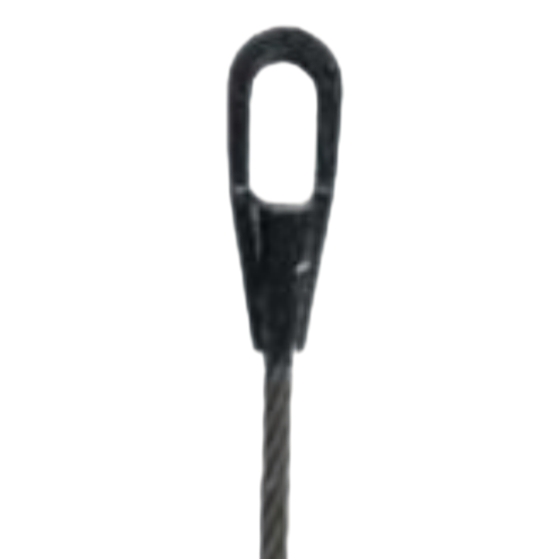
浇筑闭式索节
- Product details
-
Closed cable joint, also known as closed casting sling, its core feature is that the cable joint body is a whole hollow cone, without opening or pin connection structure. According to the national standard GB/T 30588-2014 "Wire rope end, alloy melting and casting Sleeve", closed cable joint is a standard form of alloy melting and casting Sleeve, suitable for lifting or towing wire rope with a diameter of not less than 6mm.
Structure: One end is a hollow conical cavity for casting, and the other end is made of eye rings, fork heads and other structures for connecting other rigging.
Model: In the standard, the code name for closed cable joints is usually "B".
? Alloy melting and casting process
This is the core process of making a cast closed cable joint. According to national standards, the main steps are as follows:
Wire rope treatment:
Cleaning: Clean the end of the wire rope thoroughly to remove oil and impurities.
Loose head: the end of the wire rope strands of steel wire in turn spread out, in the shape of a broom or lantern.
Core treatment: If it is a fiber core steel wire rope, it needs to be cut and removed, and protected by a heat-resistant material plug; if it is a steel core, it needs to be spread out.
Penetrating cable joint: Penetrate the treated wire rope end into the conical cavity of the closed cable joint body.
Casting consolidation: heating Babbitt (such as zinc-based, tin-based, or lead-based alloys) to a molten state, and then pouring it into the tapered cavity of the cable joint, so that the molten alloy is completely filled and wrapped around the scattered steel wires.
Cooling forming: After the alloy cools and solidifies, the wire rope and the cable joint form a high-strength, non-removable integral joint.
? Features and requirements
High strength: A qualified closed cable joint should be able to withstand 100% of the minimum breaking force of the wire rope, and its breaking tension coefficient is higher than that of ordinary rigging, making it a reliable choice under static tension conditions.
Material requirements:
Cable joint body: usually made of high-quality carbon steel or low-alloy cast steel, and heat-treated to ensure sufficient strength and toughness.
Wire rope: The strength level is usually not less than 1670 MPa.
Casting materials: mainly using zinc-aluminum-copper alloys, zinc-copper alloys or Babbitt alloys that meet standards.
Surface treatment: To prevent corrosion, all structural parts of the cable joint usually require hot-dip galvanizing treatment.
related products
Product Inquiry
Please leave your message, we will contact you quickly after receiving it, thank you for your support!
common problem
Q
What kind of lubricant can prevent wire rope damage?
A
Second, the lubricating oil adhered to the wire rope will not be easily wiped off, and the smoothing effect will not be affected within the specified temperature range. In addition, the lubricating oil with adhesive function can also prevent skid, which provides assistance for the friction of the elevator wire rope.
Third, it has a high oil film strength, which can resist the extremely high pressure between the steel wires in contact with each other under extremely heavy load, and can also resist decomposition and transformation.
Fourth, smooth oil has high cohesion, which can avoid the dripping of smooth oil, centrifugal loss when there is no exercise, and avoid grease waste and pollution to other equipment.
Fifth, it does not contain ingredients that can cause corrosion and rust in the steel wire rope, and the effect of anti-corrosion and anti-rust is better.
Sixth, its self-correcting ability is strong. When the wire rope is used, it constantly twists and turns, which will cause the surface oil film to continuously knead and expand. This requires a soft and high-temperature oil film to maintain the rope body from cracking.
Q
What are the classifications of wire ropes?
A
2, tower crane wire rope and multi-strand non-rotating wire rope: 6 * 19 + FC- 12/12.5, 6 * 37-13/14, 6 * 29FI + FC- 12/12.5, 4v39s + 5FC- 12/13/14, 35W * 7-12/13/14
3, car crane does not rotate wire rope: 4V39S + 5FC- 10/12/13/14/16/17, 35W * 7-10/12/13/14/15/16/17/18/20/22
4, pile driver flat wire rope: K6K36WS + IWR-/17.5/24/26/28/30/32/34/36/40/42/46
5, rotary excavator flat wire rope: 35W * K7- 24/26/28/30/32/36/40
6, dock crane wire rope: 6 * 36WS + IWR- 17.5/19 5/21.5/24/26
7, mine wire rope 6 * 19 + FC- 12.5/14/15.5/17/18.5/21 5/24.5/26/28, 6 * 19S + FC- 12.5/14/15.5/17/18.5/21 5/24.5
8, elevator wire rope: 8 * 19S + FC- 10/11/12/13/16
9. Hot-dip galvanized hanging basket wire rope: 4 * 31WS + PPC- 8.3/8
10. Hot-dip galvanized wire rope: 6 * 19/6 * 37/6 * 36WS/8 * 61/8 * 36WS/
11, galvanized wire rope: 6 * 7 + FC-/2/3/4
6 * 19 + FC-5/6/7 7/9.3/11, 6 * 12 + 7FC-5/6/7. 7/9.3/11, 7 * 19-5/6/8/10, 19 * 7-4/5/6/8/10, 6 * 37 + FC-8.7/9 3/11/13/15/17.5/19.5
12. Large diameter wire rope: above 60MM
13. Wire rope rigging (insertion, pressing, pouring, connectors, etc.):
14, coated wire rope: 2-3/3 - 4/4-5/5-6/6 - 8/8-12/12-15
15, binding wire rope: 6 * 12/6 * 15-13/14/15
The front represents the structure, and the back represents the diameter. For example: 6 * 37 + FC-11, the representative structure is 6 * 37 + FC, diameter: 11MM
Copyright © 2012-202X Jiangsu Dingtian Technology New Materials Co., Ltd. All rights reserved